72 hr
Milan Hop-On Hop-Off Open-Top Bus Tour
- Expert local guide
- Small group
- Skip-the-line access
- Free cancellation
Milan Hop On Hop Off Bus — Open-Top Routes & 24-Hour Tickets
Ride the city from Duomo to castle, boarding where you please.
Compare fares, pick the fit — all bookings are mobile-voucher and eligible for free cancellation where shown.
72 hr
24 hr
First-time visitors booking a milan hop on hop off bus ticket choose between a 24-hour standard pass, longer 48/72-hour multi-day tiers, and a weekend 72-hour bundle that adds the Milan Night Tour. All tiers cover the same four routes across the historic center, so the real decision is validity window and whether an after-dark loop matters to you.
|
Top pick 24-Hour Standard (All 4 routes) |
48/72-Hour Multi-Day (Extended validity) | 72-Hour Weekend + Night Tour (June–September, Sat/Sun) | |
|---|---|---|---|
| Validity window | 24 hours from first use | 48 or 72 hours from first use | 72 hours, weekend departure only |
| Price tier | 25 EUR per adult | Higher than 24-hour rate | Highest tier, weekend surcharge |
| Routes included | Lines A, B, C, D | Lines A, B, C, D | Lines A, B, C, D plus night loop |
| Night Tour access | — | — | ✓ (June–Sept, Sat–Sun only) |
| Best for | First-timers on a single-day visit | Multi-day stays or slower pace | Weekend travelers wanting evening views |
| See tickets & prices |
Verdict: Same-day sightseers should stick with the 25 EUR 24-hour milan hop on hop off bus tour, while weekend visitors in summer who want the illuminated Duomo and Sforza Castle should upgrade to the 72-hour bundle with Night Tour access.
Worth it for first-timers, skippable for locals
The milan hop on hop off bus runs 25 EUR for a 24-hour adult ticket, and whether that pays off depends entirely on who you are. First-time visitors get real value: one fare links the Duomo, Sforza Castle, and the Brera district without decoding tram maps or buying separate metro fares. Spread across a full day of city sightseeing tours, 25 EUR is roughly the cost of three single metro rides plus a guided walk, so the convenience math holds. Locals and repeat visitors are the honest exception. Milan's centre is compact and walkable, the metro is cheap and fast, and the buses crawl in midday traffic. If you already know the landmarks, the milan hop on hop off bus tours add cost, not speed. Sentiment splits along exactly this line: tourists rate the milan hop on hop off bus tickets highly, seasoned Milan hands rate them mediocre. Match the ticket to your familiarity.
Bottom line: Buy it if it is your first Milan trip; skip it if you already know your way to the Duomo.
Choosing a milan hop on hop off bus tour usually comes down to coverage versus simplicity, and City Sightseeing wins on coverage while Milan Open Tour wins on ease. Riders after skip-the-line Milan landmarks with more flexibility tend to book City Sightseeing over Open Tour.
|
Top pick City Sightseeing |
Milan Open Tour | |
|---|---|---|
| Number of routes | 4 routes | 2 routes |
| Stops covered | 40+ stops citywide | 37 stops, two lines |
| Bus frequency | 20–50 min by route | Approx. every 60 min |
| Best for | Multi-day, neighborhood focus | One-day, simple loop |
| Route focus | Historic center, Navigli, San Siro, modern district | Highlights line + Fashion/Design/Leisure line |
| Night tour option | ✓ (summer weekends) | — |
| See tickets & prices |
Verdict: City Sightseeing suits travelers who want four distinct routes and a summer night tour, while Milan Open Tour fits visitors who prefer a shorter, easier-to-follow two-line network for a single day in Milan.
Hand-picked experiences loved by thousands of travelers
2–3 hours (self-guided, flexible)
Explore Milan's 600-year-old Gothic cathedral and soak up sweeping rooftop views stretching to the Alps.
2–3 days
Free Cancellation
One flexible pass unlocks Milan's top sights — cathedrals, canals, museums & unlimited transit.
2.5 hours
Free Cancellation
Zip through Milan's iconic streets and hidden corners on a private 2.5-hour Vespa ride with a local guide.
A 15th-century fortress rebuilt by Francesco Sforza on the foundations of a Visconti castle, now home to several city museums including one holding an unfinished Michelangelo sculpture. It is the first stop on Line A, just steps from the Largo Cairoli boarding point.
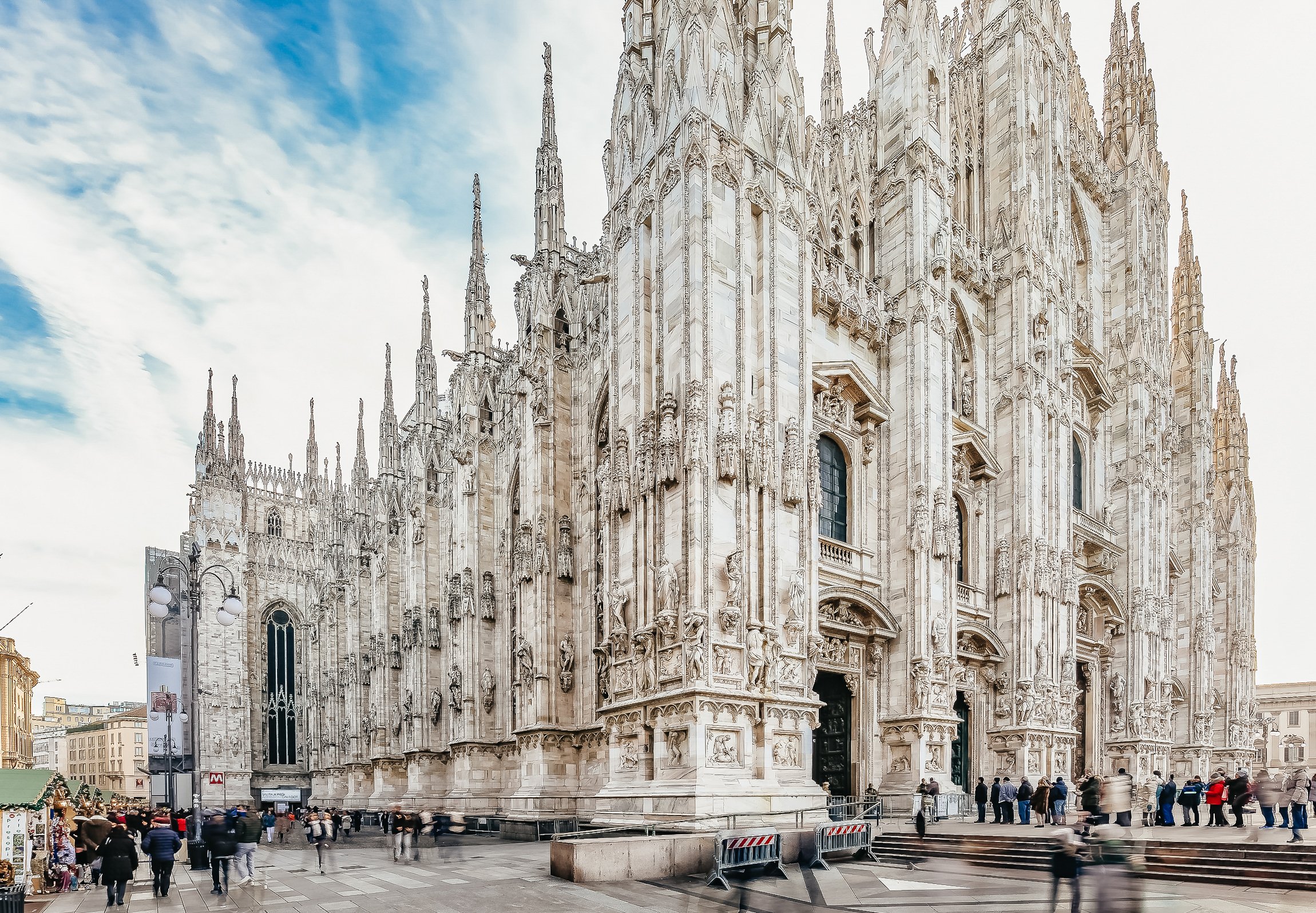
The Gothic cathedral took nearly six centuries to complete, with construction beginning in 1386 and the final bronze doors installed in the 20th century. It marks a shared stop for Lines A and B, and its 135 spires make it the busiest hop-off point on the network.
This Dominican convent church, a UNESCO World Heritage Site, houses Leonardo da Vinci's Last Supper mural in its refectory, painted between 1495 and 1498. Line A stops nearby, though entry to see the mural requires a separately timed, pre-booked ticket.
Opened in 1778, La Scala remains one of the world's most prestigious opera houses and seats around 2,000 people across its horseshoe-shaped auditorium. It sits along the historic Line A loop near the Monte Napoleone stop.
This neoclassical triumphal arch, completed in 1838 at the edge of Parco Sempione, was originally commissioned by Napoleon to commemorate his military campaigns. It anchors a stop on Line C, the route aimed at the CityLife and stadium district.
Formally named Stadio Giuseppe Meazza, this stadium seats over 75,000 spectators and is shared by both AC Milan and Inter Milan football clubs. It is a signature stop on Line C, geared toward sports-focused riders.
All the details about your upcoming adventure in one place
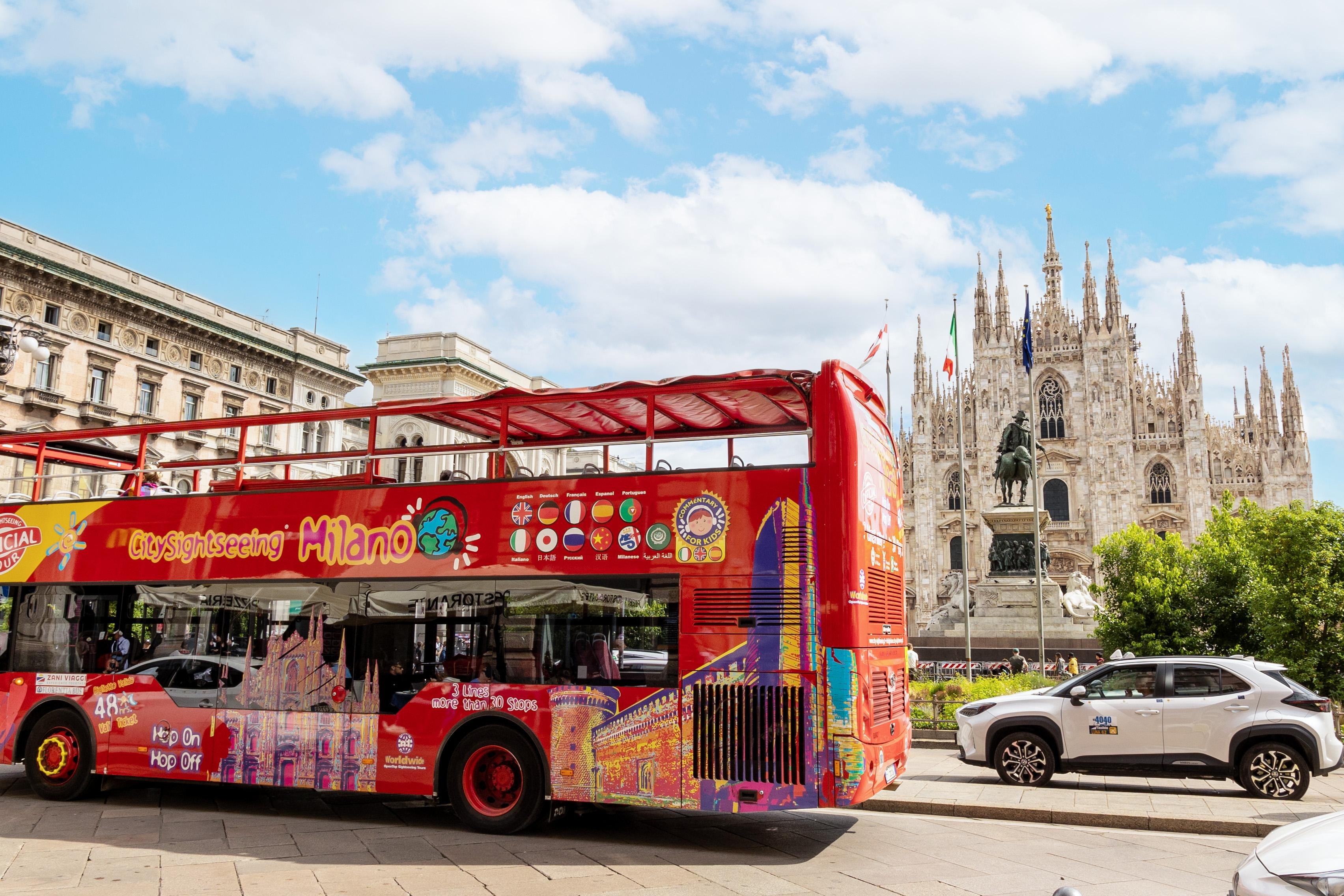
The milan hop on hop off bus links the city's major landmarks along a looping route, letting you board and alight at your own pace between the Duomo, the Navigli canals, and the Sforza Castle. Onboard audio commentary covers the Gothic cathedral, La Scala opera house, and Leonardo's legacy, so these Milan sightseeing tours double as a moving introduction to the city. With milan hop on hop off bus tickets valid across a single day or two, the open-top decks work well for first-time visitors mapping out the historic centre.
Milan's open-top sightseeing routes trace a city that only became Italy's commercial capital by refusing to sit still. The tour network, run under the City Sightseeing banner, threads together landmarks separated by centuries: the Gothic marble of the Duomo, begun in 1386 and not formally completed until the twentieth century, and the glass-and-steel towers of Porta Nuova, most of them raised after 2010. The routes exist because Milan is deceptively large and its treasures are scattered. A visitor tracing the milan hop on hop off bus network passes the Sforza Castle, the fifteenth-century Visconti-Sforza stronghold that once guarded the city and now holds Michelangelo's unfinished Rondanini Pietà. Nearby stands the Basilica of Santa Maria delle Grazie, whose refectory wall carries Leonardo da Vinci's Last Supper, painted between 1495 and 1498. The circuit also skirts the Galleria Vittorio Emanuele II, the 1877 iron-and-glass arcade that predates most of the world's shopping malls by a century. The operator's Milan service grew from a broader European sightseeing model, adapting the familiar red double-decker to a city where narrow medieval lanes meet Napoleonic boulevards. Multilingual audio commentary, delivered through onboard headsets, narrates each stretch of the route, so the ride functions as a moving lecture on Lombard history. Departures gather at Largo Cairoli, beside the castle moat, a hub chosen because it links the historic core to the shopping spine of Via Dante. Why the city still rewards this kind of survey is a matter of geography. Milan lacks a single dominant hill or river vista; its interest lies in accumulation, in the way a Roman column can stand outside a Romanesque basilica a few tram stops from a Zaha Hadid tower. A milan open-top bus tour compresses that sprawl into a legible loop, and the bus turistico milano commentary supplies the connective tissue between eras. The Brera district, with its Pinacoteca and eighteenth-century academy, and the canal-lined Navigli, engineered in part to Leonardo's hydraulic sketches, both sit within reach of the marked stops. The milan hop on hop off bus therefore serves less as transport than as an argument about the city itself: that Milan is best understood in sequence, its fashion quarter and its cathedral and its industrial waterways read as chapters rather than isolated sights. For newcomers, the milan hop on hop off bus tour offers a first draft of that reading, a rolling index of a place that has rebuilt itself after plague, occupation, and the bombing of 1943 without ever quite losing its layered grain.
Milan's interest lies in accumulation, in the way a Roman column stands a few tram stops from a Zaha Hadid tower.
Bookings for the Milan hop on hop off bus can be cancelled and refunded in full, minus a small reservation fee, up to 3 business days before the tour date. Cancellations made within 72 hours of the tour, or no-shows, are not eligible for a refund of the 25 EUR ticket price.
Weather · crowds · average price — dots go green to amber to red as each metric rises.
March through May brings mild 12-20°C weather and fewer queues at Duomo stops than summer, with Milan's fashion week crowds in late February easing by March.
Starting at the Largo Cairoli visitor center on Via Cusani lets you pick up a paper map and confirm the day's stop closures before boarding.
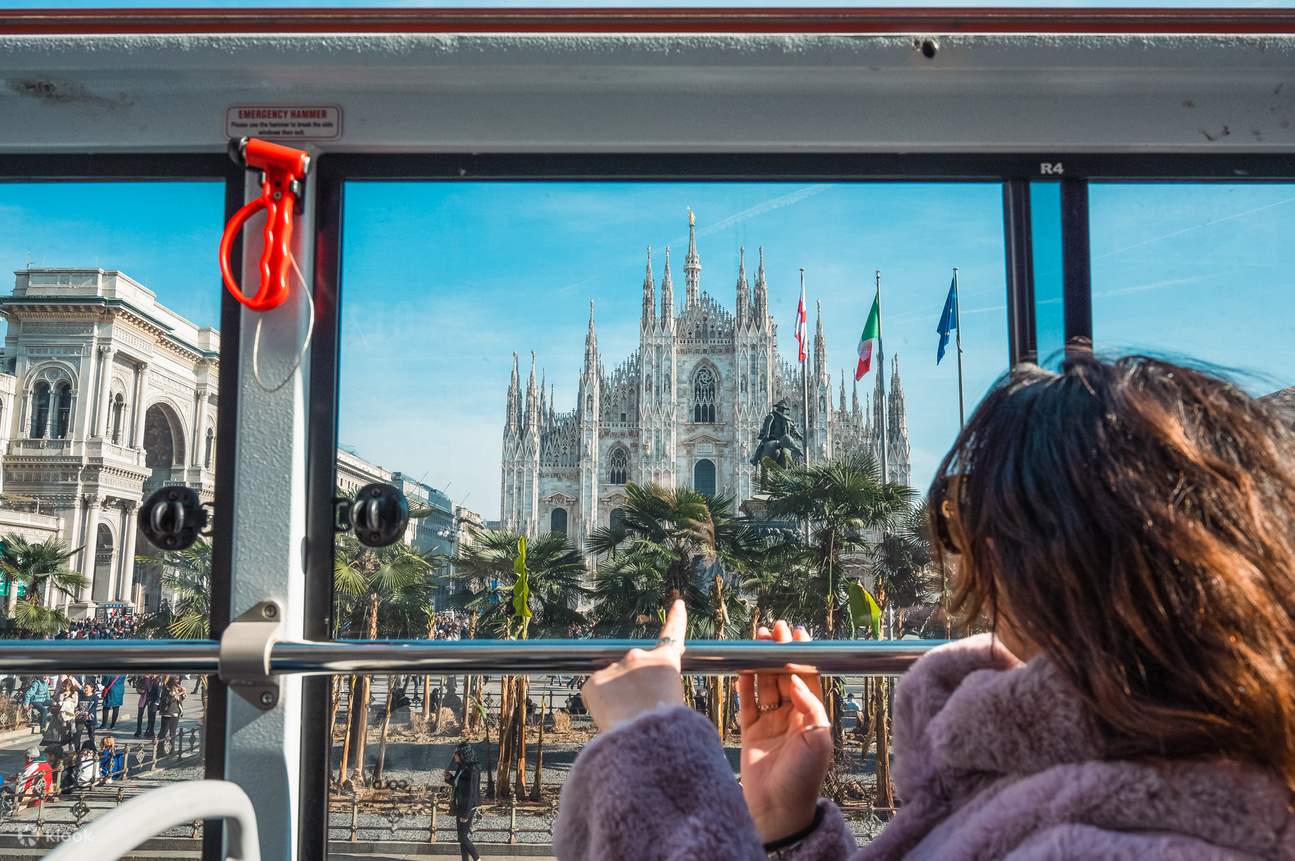
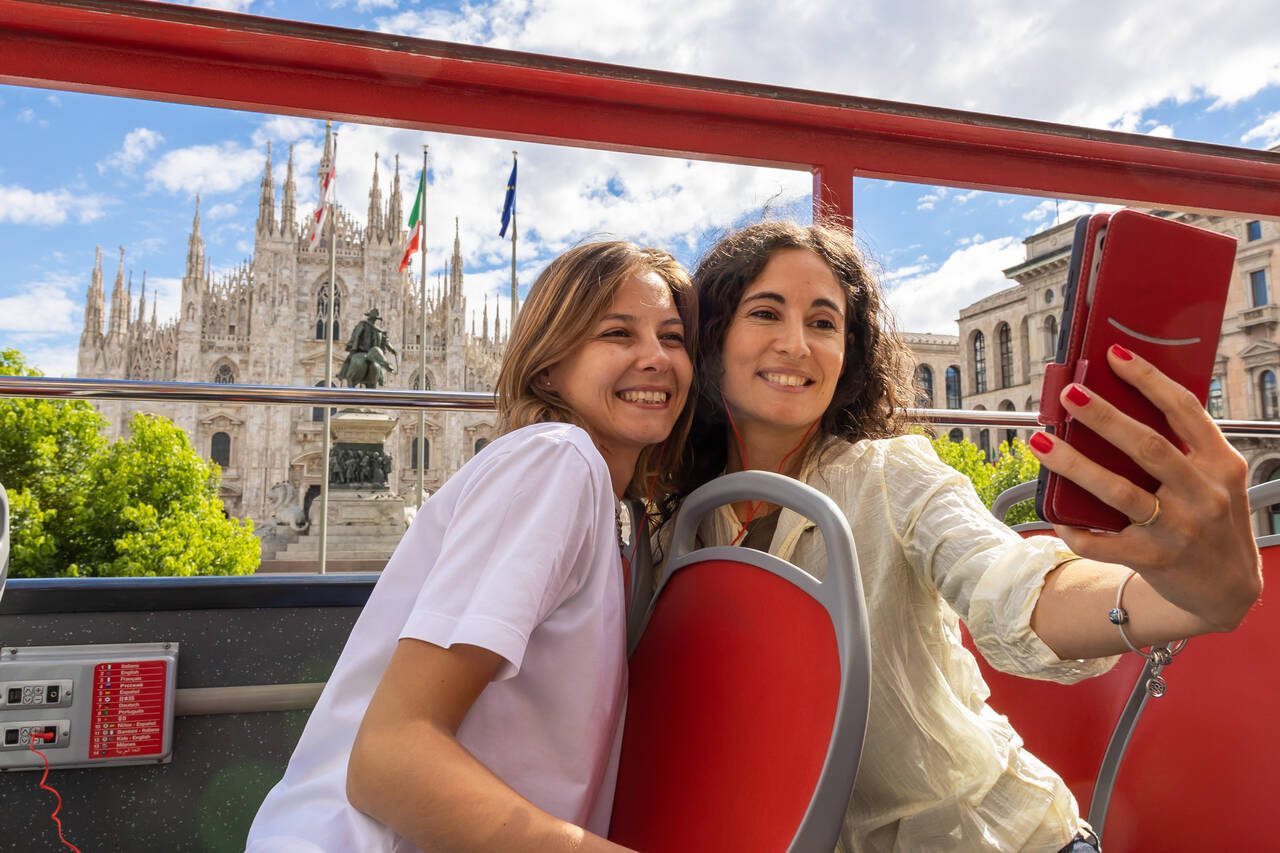
From the upper deck of the milan hop on hop off bus, the Duomo's spires and the golden Madonnina statue rise directly above the square, framed by the Galleria's glass arcade behind. Sit on the right side as the bus loops Piazza del Duomo for the cleanest angle. Best shot happens on the first circuit before crowds fill the piazza.
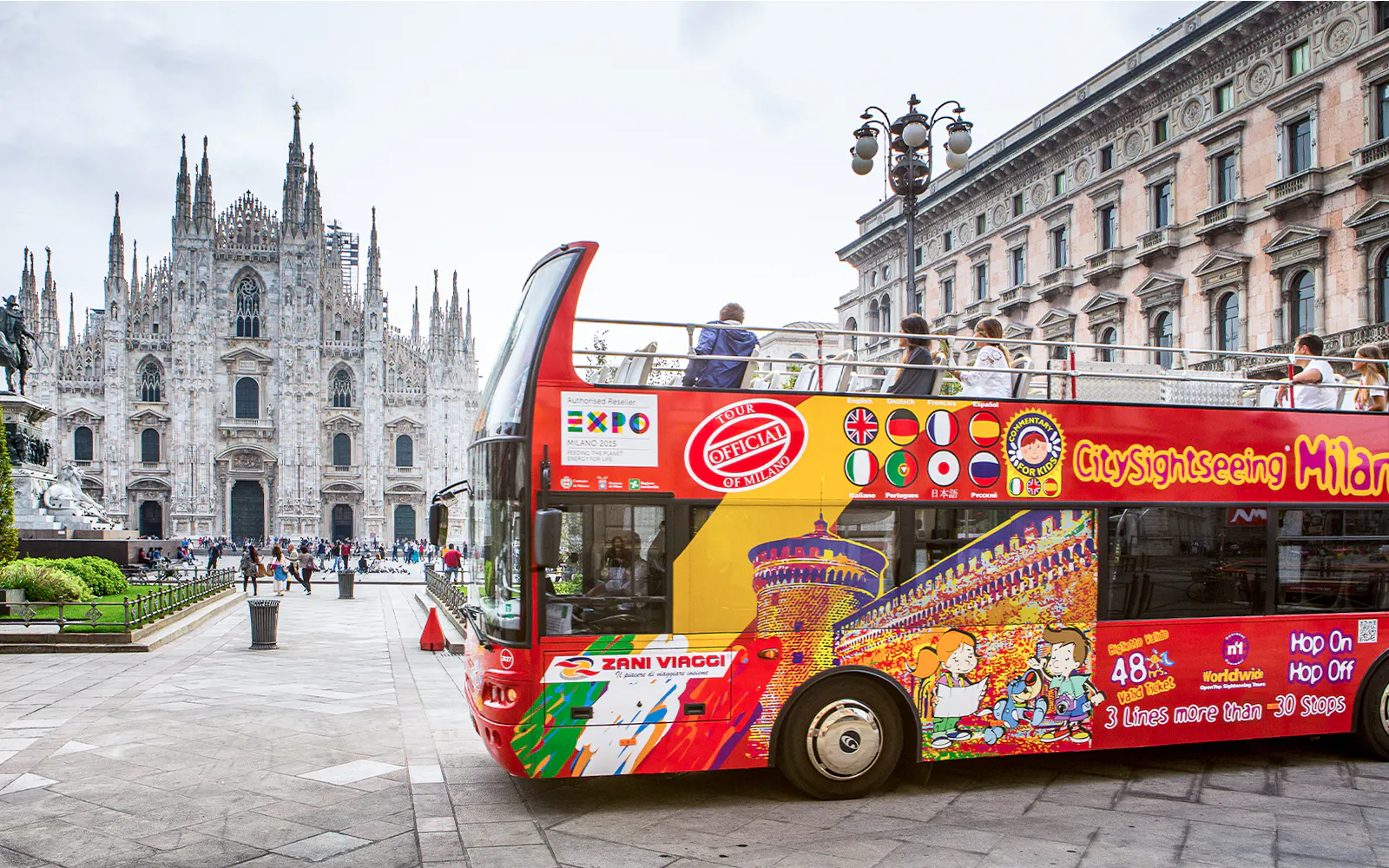
The bus route runs past the red-brick facade and twin towers of Castello Sforzesco, giving an unobstructed frontal view rarely available from street level in traffic. Shoot from the open-top deck as the bus slows near the castle's main gate. Overcast light works well against the brick tone.
This neoclassical triumphal arch sits at the far end of Parco Sempione behind the castle, its Corinthian columns and bronze chariot statue visible from the bus as it circles Piazza Sempione. The strongest composition lines up the arch with Castello Sforzesco's tower in the background. Morning sun lights the front facade where the horses face east.
Along Ripa di Porta Ticinese, the bus stop puts photographers at canal level among the Naviglio Grande's stone bridges, tenement houses, and reflections in the water. Step off here rather than shooting from the moving bus, since the narrow street rewards a stationary shot toward Ponte Alda Merini. Golden hour turns the canal water amber and draws the evening aperitivo crowd.
Between the Arco della Pace and Castello Sforzesco, the open-top deck briefly aligns both landmarks with Parco Sempione's tree canopy in one frame, a composition many milan hop on hop off bus tours highlight as a signature stretch of the route. Hold the camera steady and shoot wide to capture the depth from arch to castle. Clear days add the Branca Tower silhouette in the distance.
Riding a milan hop on hop off bus with children is genuinely relaxed: no queues to manage, just an open-top seat and rotating views of the Duomo and Sforza Castle. The main planning job is choosing which of the four routes suit your kids' attention spans, since covering all of them in one day is a lot to ask of little legs.
Buses are stroller and pram accessible, though space on the lower deck fills up fast at peak times, so fold compact strollers if you can and board early at a starting stop like Largo Cairoli.
Kids from about 4 to 11 tend to enjoy it most thanks to the multilingual audio guide, which some operators offer in a dedicated kid-friendly version; infants must sit on a caregiver's lap rather than in a stroller while the bus moves.
Pick one Milan landmarks route per day rather than chaining all four lines together. Younger children lose interest after 60-90 minutes on board, so plan two or three hops rather than a full loop.
There are no onboard toilets or baby-change facilities, so use the bathroom before boarding and time hops around stops near cafes with amenities.
The open-air top deck loses its appeal in rain, so keep to the covered lower level and treat wet days as a chance to hop off longer at indoor stops like the Duomo or Castello Sforzesco.
Everything you need to know for your journey
The lower deck of most buses used for the milan hop on hop off bus tour has ground-level access, but the open-top upper deck is reached only by a fixed staircase.
Large suitcases, glass containers, drones, and ferocious or venomous animals are not permitted on the milan hop on hop off bus; small bags that fit on your lap are fine.
Yes, photography is unrestricted on the open-top upper deck of the milan hop on hop off bus, though standing up while the bus is moving is not allowed.
Arriving between 09:30 and 10:30, right at opening, lets you catch the first departures on the milan hop on hop off bus before midday crowds build near the Duomo stop.
No formal dress code applies on the bus itself, but sites you hop off to visit, like the Duomo, require covered knees and shoulders.
There is no food or drink service on board the milan hop on hop off bus, though bottled water is fine to carry.
The Largo Cairoli meeting point at Via Cusani 18 is a short walk from Cairoli M1 metro station or Lanza M2 metro station.
Yes, children aged 5 to 15 ride at a discounted rate and children under 5 travel free on the milan hop on hop off bus tour, making it a practical option for families.
Bookings can be cancelled and refunded, minus a small reservation fee, up to 3 business days before the tour; cancellations within 72 hours are non-refundable.
Castello Sforzesco, the Duomo di Milano, Teatro alla Scala, and the Pinacoteca di Brera all sit directly on or within walking distance of the bus routes.
A 15th-century fortress built by Francesco Sforza that now houses several city museums including a Michelangelo sculpture room.
A large landscaped park behind the castle with the Arco della Pace triumphal arch at its far end.
One of the world's leading opera houses, with an adjoining museum of theatrical memorabilia.
A 19th-century glass-domed shopping arcade linking Piazza del Duomo to Piazza della Scala.
An art museum in the Brera district holding works by Raphael, Caravaggio, and other Italian masters.
A five-star property tucked behind Via Privata Fratelli Gabba with a private garden near Brera.
A design-focused boutique hotel near Teatro alla Scala with a rooftop terrace overlooking the Duomo.
A walkable art-gallery neighborhood with a mix of mid-range hotels and B&Bs close to Castello Sforzesco.
A straightforward budget chain hotel within walking distance of Cadorna station stops.
Join thousands of happy travelers who have discovered this incredible experience
Book Your Experience Now